Cordless and petrol disc cutters offer comparable professional cutting performance, but the best choice depends on the workload and environment. Cordless models provide convenient starting, reduced maintenance, and no exhaust emissions, making them well suited to intermittent cutting and indoor projects. Petrol machines remain practical for continuous heavy-duty work, particularly where charging facilities are limited. This guide compares their advantages, including real-world examples from STIHL.
Cordless vs Petrol Disc Cutters for Professional Work
For builders, landscapers, and groundworkers, a dependable disc cutter can make all the difference when tackling demanding cutting jobs. While petrol disc cutters have long been the preferred choice for professional use, advances in battery technology mean that cordless models are now capable of competing with their petrol counterparts. With both options offering distinct advantages, choosing the right machine increasingly depends on the nature of the work, site conditions, and how frequently cutting is required.
In this guide, we compare cordless and petrol disc cutters from a practical trade perspective, examining their cutting capabilities, convenience, running costs, and suitability for different working environments. We’ll also compare four professional STIHL machines to illustrate how the two technologies perform in real-world applications.
Can Cordless Disc Cutters Match Petrol Cutting Performance?
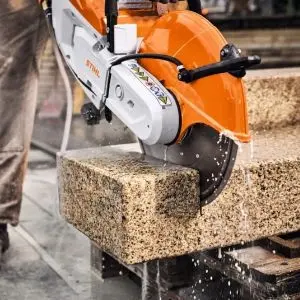 One common misconception about cordless disc cutters is that they’re only suitable for occasional light-duty tasks. Although smaller battery-powered models are popular for cutting paving, bricks, and roof tiles, larger professional machines can tackle much more demanding materials.
High-performance cordless disc cutters use powerful battery systems and advanced electric motors to cut concrete, reinforced concrete, natural stone, and steel when fitted with the correct cutting wheel. Some now offer performance comparable to petrol machines with equivalent cutting-wheel diameters.
Petrol disc cutters remain popular for demanding construction work, particularly groundworks, road building, and structural projects. Their engines provide sustained power, while quick refuelling helps maintain productivity during lengthy cutting sessions.
However, cutting capability shouldn’t be confused with sustained productivity. A cordless machine may cut through the same material as its petrol equivalent, but battery capacity determines how long it can operate before a replacement is needed.
For professionals, the important question isn’t necessarily whether a cordless disc cutter can complete a particular cut, but how much cutting it can accomplish during a working day.
Battery Runtime vs Petrol Refuelling: Which Is More Practical?
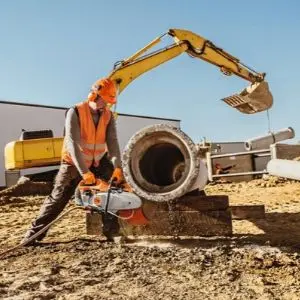 Runtime is often a deciding factor when choosing between cordless and petrol disc cutters.
Petrol machines can be refuelled relatively quickly, making them particularly convenient for continuous cutting. Cordless models require more planning, as operating time depends on battery capacity, cutting depth, and material density. Demanding applications generally consume more energy, reducing runtime.
However, actual cutting time rarely tells the whole story.
Consider a landscaper installing a patio. Much of the day involves preparing the sub-base, positioning slabs, and checking levels. The disc cutter may only be needed for occasional adjustments, making cordless operation particularly convenient.
By contrast, a groundworker cutting concrete continuously may find petrol refuelling more practical. Spare batteries and fast chargers can reduce interruptions, but contractors should assess their likely workload before investing in cordless equipment.
Why Cordless Disc Cutters Are Particularly Useful Indoors
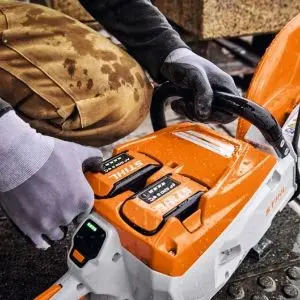 Working conditions can significantly influence which power source is most appropriate.
Petrol disc cutters produce exhaust fumes, including carbon monoxide, making them unsuitable for indoor or poorly ventilated environments. Cordless machines produce no exhaust emissions at the point of use, offering clear advantages for building alterations, refurbishment projects, and other enclosed working areas.
Battery-powered models also tend to generate less noise, particularly because there’s no engine idling between cuts. This can be beneficial around occupied properties, residential developments, and other noise-sensitive locations.
However, cordless operation doesn’t eliminate cutting hazards. Airborne silica dust remains a serious concern when cutting concrete or masonry. Appropriate dust suppression or extraction, respiratory protection, and other safety measures remain essential, regardless of the machine’s power source.
Starting, Handling, and Portability
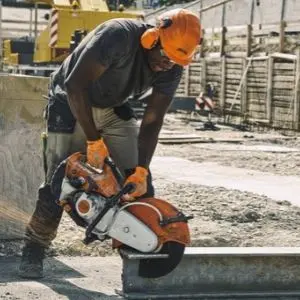 Cordless disc cutters start without pull cords, fuel preparation, or engine warm-up. Operators can make a cut, release the trigger, and move on without leaving an engine running. This makes them particularly convenient for paving installations and property maintenance work involving repeated, short cutting sessions.
Petrol machines require more preparation, although modern starting systems have made them easier to operate than older models.
Vibration and handling are also important. Electric motors generally produce less vibration than combustion engines, potentially improving operator comfort. However, actual vibration exposure depends on the machine, cutting wheel, material, and operating technique.
Cordless machines aren’t necessarily lighter than petrol equivalents, especially when large batteries are fitted. Comparing ready-to-use weights, balance, and cutting visibility is therefore more useful than judging machines by their power source alone.
Portability involves more than just machine weight. Cordless disc cutters eliminate the need to carry petrol, but spare batteries and chargers can add bulk. Petrol models require fuel, yet remain practical on remote sites without electricity. The best choice depends on transport requirements and access to charging facilities.
Maintenance and Long-Term Running Costs
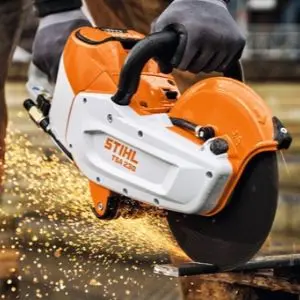 Petrol disc cutters require regular engine maintenance, including attention to air filters, spark plugs, and fuel systems. Dusty construction environments can make servicing particularly important.
Cordless machines eliminate many engine-related maintenance tasks, although cutting wheels, guards, water connections, and other mechanical components still require inspection. Batteries must also be stored, transported, and charged correctly.
Running costs depend on how frequently the machine is used. Petrol models involve ongoing fuel purchases and servicing, while cordless equipment requires electricity and eventual battery replacement.
Professional batteries and chargers can represent a substantial initial investment. However, businesses already using compatible cordless tools may benefit from sharing batteries across their existing equipment.
Contractors should therefore consider total ownership costs rather than focusing solely on purchase price.
Two Real-World Comparisons: STIHL Cordless vs Petrol Disc Cutters
The practical differences between cordless and petrol disc cutting become clearer when comparing machines designed for similar professional applications.
STIHL offers closely matched battery-powered and petrol disc cutters with equivalent cutting-wheel diameters. The following examples demonstrate how each technology suits different working patterns without necessarily compromising cutting capability.
Case Study 1: STIHL TSA 300 vs STIHL TS 410 – Professional 12-Inch Disc Cutters
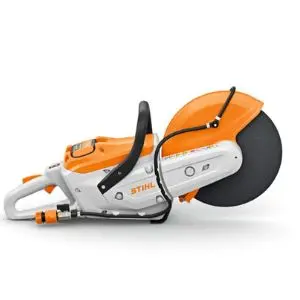 The STIHL TSA 300 and TS 410 provide a useful comparison because both use 12-inch (300 mm) cutting wheels and are designed for professional applications.
The STIHL TSA 300 Cordless Cut-Off Machine belongs to STIHL’s professional ALLPRO/ AP battery system. Its powerful electric motor delivers cutting performance comparable to the petrol-powered TS 410, with a maximum cutting depth of 110 mm. It’s suitable for cutting concrete, brick, steel, and natural stone when fitted with the appropriate wheel.
Low-vibration operation and a narrow cutting kerf help improve precision, while a fast-stop brake brings the wheel to a halt in under four seconds after the trigger is released. These features are particularly useful for repeated, accurate cuts during landscaping or construction work.
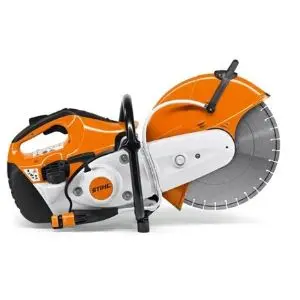 The STIHL TS 410 Petrol Cut-Off Machine uses a 66.7 cc engine producing 3.2 kW. It offers a maximum cutting depth of 100 mm, alongside an anti-vibration system, long-life filtration, and ergonomic design suited to demanding site conditions.
For a landscaper installing decorative paving, the TSA 300 offers convenient starting and no engine exhaust fumes during intermittent cutting. However, a groundworker making repeated cuts through concrete or asphalt may favour the TS 410 because it can be refuelled quickly.
Neither machine is inherently better. Their suitability depends on cutting frequency, site conditions, and the availability of fuel or charged batteries.
Both the STIHL TSA 300 and TS 410 disc cutters are available from Ron Smith & Co, offering professional users two capable approaches to 12-inch cutting.
Case Study 2: STIHL TSA 500 vs STIHL TS 500i – Heavy-Duty 14-Inch Cutting
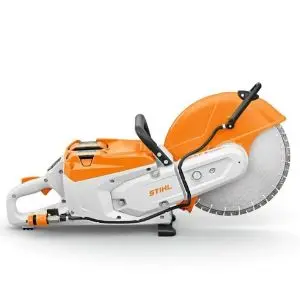 For more demanding construction work, the STIHL TSA 500 and TS 500i demonstrate how closely modern cordless technology can compete with established petrol performance.
Both machines accommodate 14-inch (350 mm) cutting wheels and offer a maximum cutting depth of 125 mm. They’re suitable for substantial cutting applications involving concrete, reinforced concrete, masonry, and steel when equipped with the correct wheel.
The STIHL TSA 500 Cordless Cut-Off Machine uses two compatible ALLPRO/ AP batteries to power a 72 V motor, delivering up to 4.2 kW of mechanical output. STIHL compares its cutting performance directly with the petrol-powered TS 500i.
Its low-vibration operation, instant starting, and lack of exhaust emissions make it particularly attractive where operator comfort and working conditions are priorities. Advanced electronics also help maintain consistent power during battery discharge.
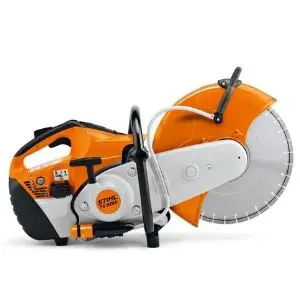 The STIHL TS 500i Petrol Disc Cutter features a 72.2 cc engine producing 3.9 kW. Its electronically controlled fuel injection system automatically adjusts fuel delivery to operating conditions, helping maintain dependable performance during demanding cutting work.
Electronic water control, effective anti-vibration technology, and long-life air filtration further support its suitability for professional construction environments.
For building contractors carrying out structural alterations, the TSA 500 offers substantial cutting capacity without engine exhaust emissions. Conversely, civil engineering teams working continuously outdoors may prefer the TS 500i, as quick refuelling reduces the need for an extensive battery-charging arrangement.
This comparison demonstrates that cutting capability is no longer necessarily the main distinction between professional cordless and petrol disc cutters. Working conditions, operating time, and daily productivity are often more important.
Both the STIHL TSA 500 and TS 500i disc cutters are available at Ron Smith & Co.
Which Disc Cutter Is Best for Your Trade?
 Landscapers and paving contractors may find cordless disc cutters particularly convenient because cutting is often intermittent. Their reduced noise and lack of exhaust fumes are also welcome around residential properties.
Builders and renovation specialists can benefit from similar flexibility, particularly when undertaking indoor alterations or working in enclosed spaces where petrol exhaust would present a hazard.
Groundworkers, road construction teams, and civil engineering contractors may favour petrol machines when cutting is continuous, materials are demanding, and charging facilities are limited.
However, these distinctions aren’t absolute. A landscaper undertaking extensive hardscaping may prefer petrol, while a contractor working on a site with strict emissions requirements might choose cordless.
The best approach is to consider workload, required cutting depth, working environment, and available power supplies before making a decision.
Cordless or Petrol: Which Is the Better Investment?
Modern cordless disc cutters have significantly narrowed the performance gap with petrol machines. For many professional applications, they now offer comparable cutting capabilities alongside convenient operation and reduced engine maintenance.
Nevertheless, petrol disc cutters retain important advantages for sustained cutting, remote locations, and contractors who prefer straightforward refuelling.
Rather than viewing cordless as a universal replacement for petrol, it’s more useful to recognise the strengths of each technology. Some businesses may benefit from owning both, allowing operators to choose the most suitable machine for each job.
Ultimately, the best disc cutter isn’t necessarily the most powerful, but the one that allows you to complete your work safely, efficiently, and with minimal unnecessary interruptions.
Buy Professional STIHL and Husqvarna Disc Cutters Here
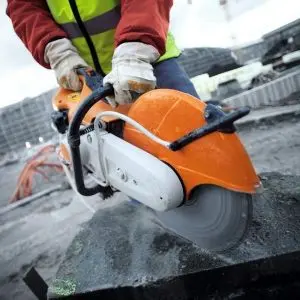 At Ron Smith & Co, we sell a comprehensive range of STIHL and Husqvarna disc cutters, including high-performance cordless models and powerful petrol machines for demanding professional applications.
Whether you’re looking for a battery-powered cut-off saw for landscaping or a heavy-duty petrol disc cutter for construction and groundworks, our range includes machines to suit a wide variety of trades and cutting requirements.
We also stock essential disc cutter accessories, including cutting wheels and other equipment to help you get the best from your cut-off machine.
If you have any further questions about choosing a cordless or petrol disc cutter, our friendly staff are happy to offer the benefit of their expertise. With showrooms in Hereford and Worcester, we’re here to help you select the right machine and accessories for all of your cutting requirements.