Avoid lawn stripes and overfeeding by using the correct lawn spreader settings, maintaining a steady walking pace, and overlapping passes evenly. This guide explains how to use a lawn spreader properly, including calibration tips, fertiliser and grass seed application advice, and practical techniques for achieving even coverage across your lawn.
How to Avoid Stripes When Using a Lawn Spreader
A healthy lawn rarely happens by accident. Behind that rich green colour and even growth is usually a careful routine of feeding, seeding, and maintenance carried out at the right time and in the right way. One of the most useful tools for this job is a lawn spreader. However, while these machines are designed to make lawn care easier, incorrect use can quickly lead to unsightly stripes, patchy growth, and overfed areas that spoil the finish of your lawn.
If you’ve ever applied fertiliser only to find dark green bands running across the grass a week later, or scattered seed and ended up with thick and thin patches, you are certainly not alone. Most striping problems come down to incorrect spreader setup, uneven overlap, or poor application technique rather than the product itself.
The good news is that once you learn how to use a lawn spreader correctly, achieving even coverage becomes a whole lot simpler. Whether you’re applying fertiliser, grass seed, or lawn treatments, a few practical adjustments can make all the difference.
Why Lawn Stripes Happen
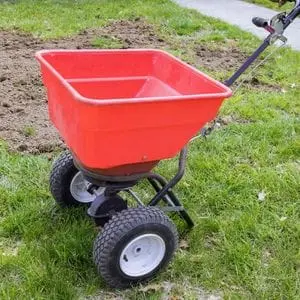 Striping caused by a spreader usually appears because some areas of the lawn receive more material than others. This is especially common with rotary or broadcast spreaders, which spread product in a wide fan pattern.
The centre of the spread pattern typically receives the heaviest application, while the outer edges receive less. If the passes across the lawn are too far apart, pale stripes can appear where there has not been enough overlap. On the other hand, if the overlap is too heavy, dark green bands or fertiliser scorch may develop.
Incorrect lawn spreader settings are another common cause. If too much product is released through the hopper, the lawn can become overfed very quickly. Damp materials, inconsistent walking speed, and turning while the spreader is still dispensing can also lead to uneven results.
Understanding these causes is the first step towards preventing them.
Choosing the Right Type of Lawn Spreader
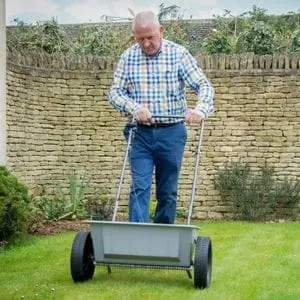 Before looking at technique, it helps to understand the difference between the two main spreader types.
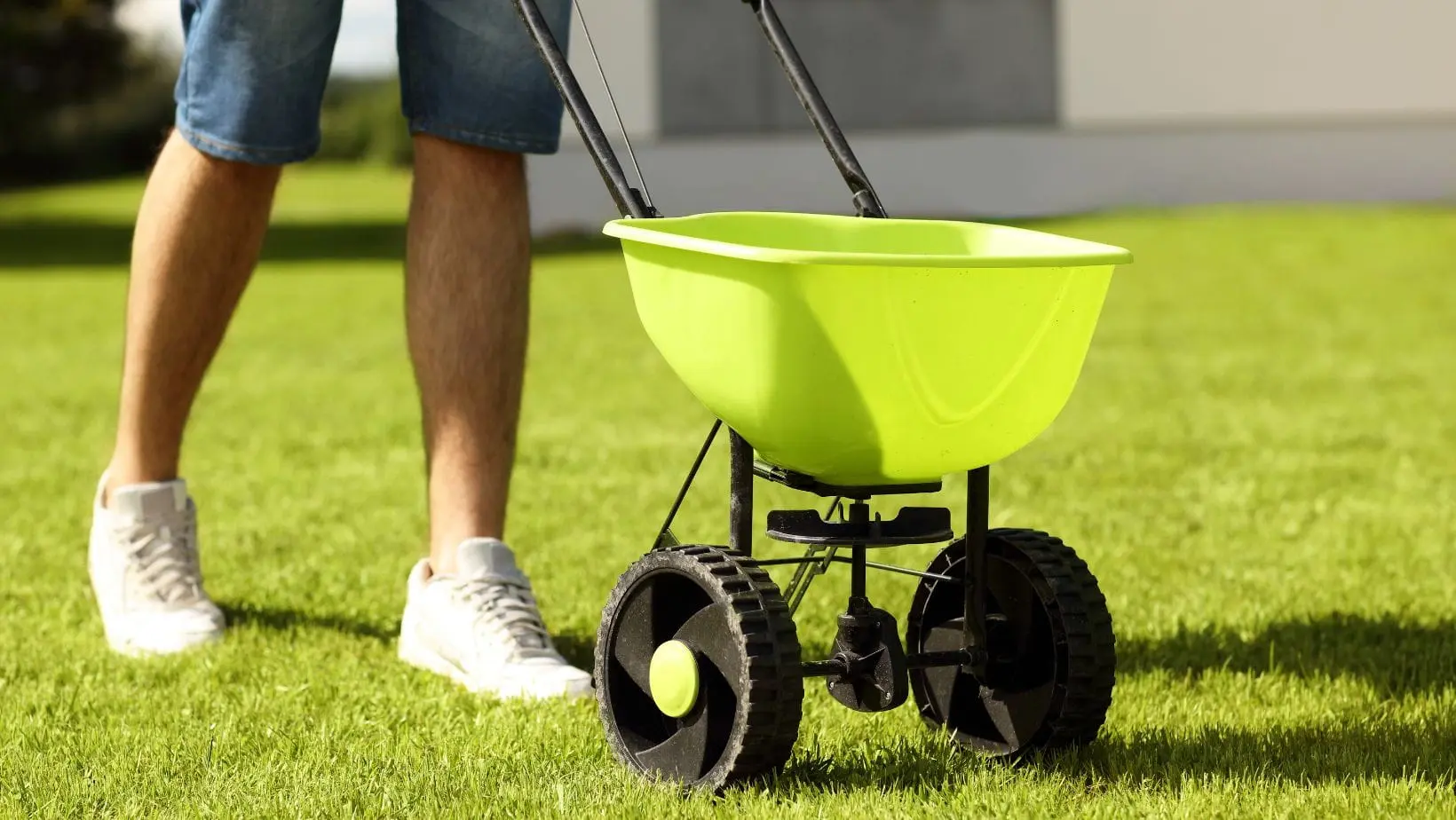
Rotary spreaders, also known as broadcast spreaders, use a spinning disc to throw material across a wide area. They are ideal for medium and large lawns because they cover ground quickly. However, they require careful overlap control to avoid striping.
Drop spreaders release material directly beneath the machine. They are slower to use but offer greater precision, making them useful around borders, flowerbeds, and smaller lawns.
Both types can produce excellent results when set up correctly, but rotary spreaders demand slightly more attention to spacing and walking lines.
Why Correct Spreader Calibration Matters
One of the most important parts of using a spreader properly is calibration. Every product flows differently, so the same setting cannot be used for everything.
For example, fertiliser granules are heavier than grass seed, while coated lawn feeds may flow more slowly through the hopper. This is why checking lawn fertiliser spreader settings and lawn seed spreader settings before starting is essential.
Many manufacturers provide a lawn spreader settings chart on the packaging of their products. This chart gives guidance on the correct opening size or flow rate for specific spreader models. While these recommendations are useful, they should still be treated as a starting point rather than an exact science.
It is often better to begin with slightly conservative settings on lawn spreader controls and increase the flow gradually if needed. Applying too little can be corrected easily, whereas overfeeding is far more difficult to fix.
The Importance of Walking Speed
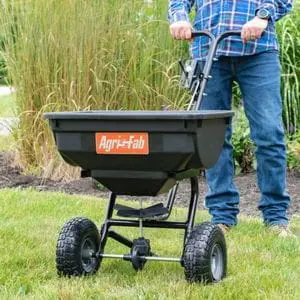 Even with perfect grass spreader settings, inconsistent walking speed can ruin the final result.
Most spreaders are designed to operate at a normal, steady pace. Walking too slowly allows excess material to fall in one area, while moving too quickly reduces coverage. Frequent stopping and starting can also create concentrated patches of fertiliser or seed.
Maintaining a smooth rhythm across the lawn helps ensure even application from one pass to the next. It also improves the consistency of the spread pattern, particularly when using rotary machines.
Professional groundskeepers tend to treat lawn spreading a bit like mowing. Straight lines, steady movement, and measured overlap all contribute to a more uniform finish.
How Overlap Affects Lawn Appearance
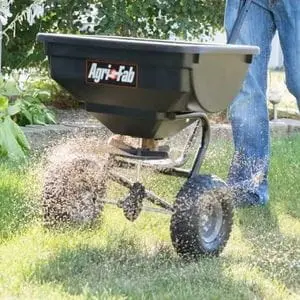 Overlap is perhaps the biggest factor in preventing lawn stripes.
With rotary spreaders, the product is not distributed evenly from edge to edge. The centre of the spread pattern receives the most material, with coverage tapering off towards the outside.
Because of this, each pass should overlap the previous one slightly. Too little overlap leaves pale bands, while too much creates darker stripes caused by excess fertiliser.
Most lawn professionals recommend overlapping each pass by around a quarter of the spread width. Using visible wheel tracks or fixed points in the garden can help maintain consistent spacing.
Working in straight, methodical lines also prevents accidental gaps and double coverage.
Why the Crosshatch Method Works So Well
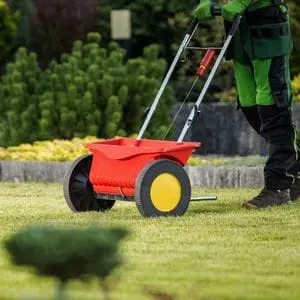 If you’re learning how to use a lawn spreader, one of the most effective ways to avoid striping is to divide the application into two lighter passes instead of one heavy pass.
This technique involves applying half the required amount while travelling in one direction, then applying the second half at right angles to the first pass. For example, the first application may run north to south, while the second runs east to west.
This approach dramatically improves coverage consistency because it reduces the chance of concentrated bands forming in any one direction.
The crosshatch method is particularly useful when applying fertiliser during the growing season or overseeding lawns in spring and autumn.
Dry Product Makes a Huge Difference
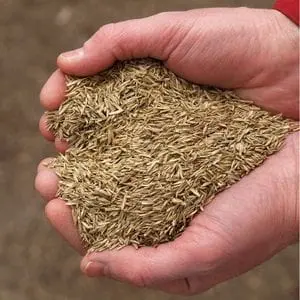 Even the best spreader can struggle if the product inside the hopper is damp.
Moist fertiliser and grass seed tend to clump together, causing irregular flow rates. This can lead to sudden dumps of material that create scorch marks or heavy patches across the lawn.
For best results, products should always be stored in dry conditions before use. It is also wise to avoid spreading during heavy dew or immediately after rainfall.
Checking the hopper occasionally during application helps catch any bridging or blockages before they become a problem.
Keeping the spreader itself clean is equally important. Residue left inside the hopper can absorb moisture and affect future applications.
Turning Correctly at the End of Each Pass
A surprisingly common mistake is leaving the spreader open while turning at the end of each run.
With rotary spreaders especially, the spinning disc continues to throw material sideways during turns. This often results in dark semicircles or concentrated patches near lawn edges.
The simplest solution is to close the hopper before turning, reposition the machine, and reopen it once moving straight again. While this adds a few extra seconds to the job, it greatly improves the consistency of the final finish.
Avoiding Problems Around Lawn Borders
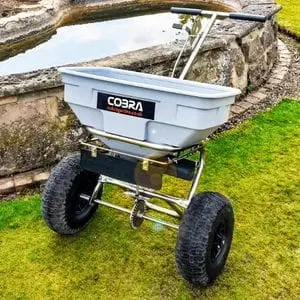 Edges and borders are often where overfeeding becomes most noticeable.
Broadcast spreaders naturally throw material sideways, making it easy to accidentally apply fertiliser to flowerbeds, patios, or driveways. Excess fertiliser along lawn edges can also create dark stripes where passes overlap too heavily.
Many modern spreaders now include edge guards or deflectors to help control spread direction. If your machine does not have one, it can help to complete the perimeter first before filling in the centre of the lawn.
This creates a controlled boundary area and reduces the risk of over-application around edges.
What to Do If Stripes Appear
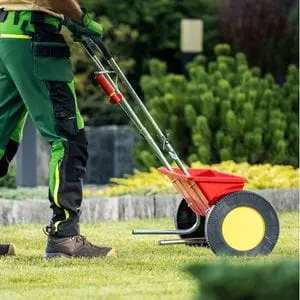 Even experienced users occasionally make mistakes. Fortunately, lawn stripes are often temporary and can usually be corrected.
Dark green stripes are normally caused by excess fertiliser. In these cases, thorough watering can help dilute the concentration and reduce the risk of scorching. Regular mowing also helps the lawn return to a more uniform appearance over time.
Pale stripes usually indicate underfeeding or insufficient overlap. Applying a light corrective feed to the affected areas can help even out the colour, although care should be taken not to overcompensate.
If striping occurs after seeding, lightly overseeding the thinner areas and maintaining good moisture levels will usually encourage more balanced growth.
Taking Time to Test Before Starting
One of the simplest ways to improve results is to carry out a quick test run before applying anything to the lawn itself.
Running the spreader briefly on a driveway or hard surface makes it easier to see the actual spread pattern. This allows adjustments to be made to lawn spreader settings for grass seed and other products before committing to the full application.
Testing also helps users become more familiar with hopper flow rates, walking speed, and overlap spacing.
Small adjustments at this stage can prevent much larger problems later on.
Achieve a Better Lawn Finish with the Right Spreader
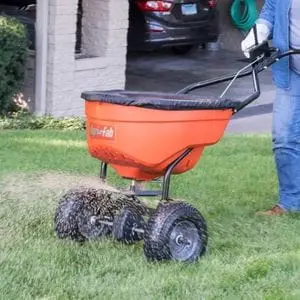 Using a lawn spreader properly is one of the easiest ways to improve the health, colour, and appearance of your lawn. By paying attention to calibration, overlap, walking speed, and product condition, it becomes much easier to avoid stripes and overfeeding.
Whether you’re applying fertiliser in spring, overseeding in autumn, or maintaining a year-round lawn care routine, investing in a quality spreader can make the entire process quicker, cleaner, and much more accurate.
At Ron Smith & Co, we sell a superb range of garden spreaders designed for domestic users, landowners, and professional groundskeepers alike. From compact drop spreaders for precise applications to larger rotary spreaders for wide open lawns, our collection includes top-quality machines from trusted brands, built to deliver reliable performance season after season.
And if you ever need advice on choosing the right spreader to help you achieve a greener, healthier lawn, please get in touch with our friendly team, who will be delighted to offer you their expert advice.